Orlin: A Handwriting Cartoon Font for Professional Creative Workflows
In the landscape of digital typography, finding a typeface that balances playfulness with professional utility is often a challenge. Many cartoon fonts lack the structural integrity required for commercial use, while serious display fonts often miss the organic charm needed for specific creative projects. Orlin addresses this gap directly. It is a handwriting cartoon font designed to bridge the aesthetic divide between bubble panel comics and traditional sign painter lettering. For professionals ranging from graphic designers and marketers to educators and small business owners, Orlin offers a versatile asset that fits seamlessly into established design workflows without compromising on quality or readability.
Understanding the Design Philosophy of Orlin
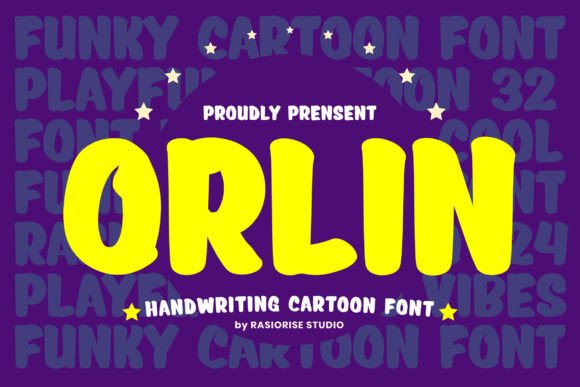
To integrate any new asset effectively, one must first understand its core characteristics and intended application. Orlin is not merely a decorative script; it is a functional tool inspired by two distinct historical traditions. The primary influence comes from the bold, energetic lines found in classic comic book speech bubbles. This gives the font an immediate sense of movement and personality. Simultaneously, it incorporates the precision and weight variation characteristic of hand-painted signage. This dual inspiration results in a typeface that feels freestyle yet maintains a solid, grounded structure.
The font includes a comprehensive set of characters, covering regular uppercase and lowercase letters, numerals, and essential punctuation. Crucially, it supports multilingual usage, making it accessible for international projects. This breadth ensures that when you select Orlin for a project, you are not limited to short headlines or English-only content. Whether you are designing a logo for a global brand or creating educational materials for a diverse classroom, the character set provides the necessary coverage to execute your vision without needing to switch fonts mid-project.
Integrating Orlin into Pre-Production Planning
The decision to use a specific typeface should ideally occur during the planning phase of a project, not as an afterthought. When scoping out a rebranding effort, a children's book illustration series, or a marketing campaign, the choice of typography dictates the tone of the entire communication. Orlin is particularly well-suited for projects where the goal is to evoke nostalgia, fun, or approachability while maintaining a level of professionalism.
During the concept development stage, consider how Orlin interacts with your other visual assets. Because of its bold style, it pairs exceptionally well with flat vector illustrations, watercolor textures, and high-contrast photography. If your workflow involves mood boards, test Orlin against your color palette early. Its thick strokes can handle dark backgrounds effectively, but they also shine in light environments where the "bubble" effect can be accentuated with drop shadows or outlines. By evaluating these interactions before moving to execution, you ensure that the font enhances rather than clashes with your overall design system.
Workflow Compatibility and Asset Management
For digital creators, compatibility is a non-negotiable factor. Orlin is designed to function smoothly within standard industry software such as Adobe Illustrator, Photoshop, InDesign, and Canva. When adding Orlin to your library, organize your files systematically. Create a dedicated folder for display fonts and keep the license documentation accessible. This organizational step prevents last-minute scrambling during production and ensures that your team members have access to the correct file versions.
If you are working in a collaborative environment, verify that the font renders consistently across different operating systems. While Orlin is robust, embedding the font correctly in PDFs or exporting web-ready formats (WOFF/WOFF2) requires attention to detail. For web projects, using Orlin for headers and call-to-action buttons can significantly increase engagement due to its distinctive shape. However, always pair it with a highly legible sans-serif for body text to maintain accessibility standards.
Execution: Applying Orlin Across Diverse Use Cases
Once the planning phase is complete, the execution of the design relies on how well the font adapts to specific mediums. Orlin’s versatility allows it to transition effortlessly from digital screens to physical merchandise. Below are practical applications where this font excels within a professional workflow.
Logotypes and Brand Identity
For entrepreneurs and small business owners, creating a memorable logo is a critical milestone. Orlin serves as an excellent foundation for logotypes that need to stand out in crowded markets like food service, entertainment, education, and children's products. The sign painter influence gives the letters a custom-made feel, suggesting craftsmanship even when generated digitally. When refining a logo, take advantage of the font's open counters and bold strokes. You may find that slight kerning adjustments or manual tweaks to specific ligatures can elevate the design further, giving it a truly bespoke appearance.
Publishing and Educational Materials
Authors and publishers looking to create engaging children's books will find Orlin invaluable. The font mimics the natural flow of handwriting, which helps young readers connect with the text. In the layout process, use Orlin for chapter titles, dialogue boxes, and emphasis points. Its playful nature keeps the reader engaged without sacrificing legibility. Similarly, educators can utilize Orlin for worksheets, flashcards, and classroom posters. The clear distinction between uppercase and lowercase aids in literacy instruction, while the cartoon aesthetic makes learning materials more inviting.
Merchandise and Packaging
In the realm of product design, packaging labels and badges require typography that communicates value instantly. Orlin works exceptionally well on t-shirts, mugs, stickers, and product labels. The bold weight ensures visibility even at smaller scales, such as on bottle caps or tags. When preparing files for print, pay close attention to stroke thickness. Ensure that the smallest details remain crisp after the printing process, especially if using screen printing or embroidery techniques. The font's rounded edges translate well to various textures, making it a reliable choice for merchandise lines.
Quality Control and Long-Term Usability
Sustaining a consistent brand voice over time requires rigorous quality control. As you deploy Orlin across various touchpoints—from social media graphics to physical signage—maintain a style guide. Document the specific sizes, weights, and pairing rules for the font. This prevents dilution of the brand identity and ensures that every piece of collateral looks cohesive.
Furthermore, consider the longevity of the trend. While cartoon fonts can sometimes feel dated, Orlin's roots in classic sign painting give it a timeless quality. It avoids the overly trendy distortions that might age poorly. By anchoring your designs in these classic principles, you future-proof your visual identity. Regularly review your materials to ensure the font is still serving its purpose. If a project evolves, assess whether Orlin remains the best fit or if a complementary typeface is needed for new sub-elements.
Optimizing Efficiency in Production
Efficiency is key for freelancers and busy marketing teams. Orlin reduces the time spent searching for the perfect custom look because it delivers a hand-drawn aesthetic out of the box. Instead of hiring an illustrator to draw every letter for a headline, you can achieve a similar result in minutes. This accelerates the production timeline, allowing you to focus on strategy and refinement. However, do not rely solely on automation. Use the font as a strong starting point, then apply your professional judgment to tweak spacing and alignment for maximum impact.
Conclusion on Implementation Strategy
Successfully integrating Orlin into your creative process involves more than just installing a file. It requires a strategic approach that considers the project's goals, the target audience, and the technical constraints of the medium. From the initial planning stages to the final quality check, this handwriting cartoon font offers a robust solution for those seeking to blend fun with functionality. Whether you are crafting a logo, designing a book cover, or producing merchandise, Orlin provides the visual language needed to communicate clearly and creatively. By treating it as a core component of your design workflow, you unlock its full potential to enhance your work and deliver consistent, high-quality results.