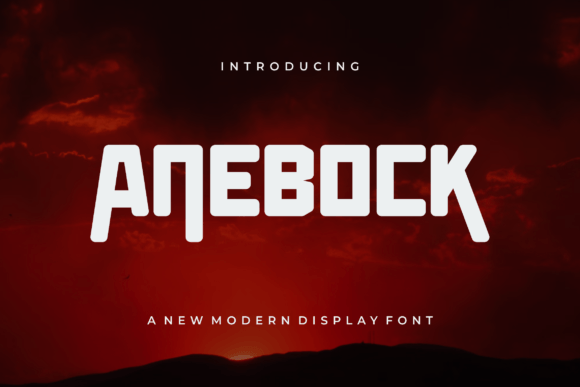
Anebock: A Bold Display Font for Authentic Branding
In the crowded landscape of digital design, finding a typeface that commands attention without screaming for it is a rare feat. Anebock emerges as a solution for those seeking a modern font that balances boldness with authenticity. It is not merely a decorative element; it is a structural component of visual communication designed to stand out in logos, t-shirt printing, and diverse branding projects. However, like any powerful tool, its effectiveness depends entirely on how you wield it. Many designers and business owners rush to download the latest trending fonts without considering the long-term implications on their brand identity.
The allure of Anebock lies in its versatility. It offers a robust character set that feels contemporary yet grounded, making it suitable for everything from streetwear labels to corporate headers. Yet, enthusiasm often leads to misuse. When a font is described as "outstanding in a wide range of contexts," there is a tendency to assume it can do everything perfectly everywhere. This assumption is where most projects stumble. Understanding the specific strengths and limitations of Anebock is crucial before integrating it into your workflow.
Understanding the True Nature of Anebock
Anebock is fundamentally a display font. In typography, display fonts are engineered to grab attention at larger sizes. They are not typically designed for long-form body text. The thick strokes, unique curves, and high contrast inherent in Anebock make it perfect for headlines, logos, and short phrases. When you use it correctly, it conveys confidence and modernity. When used incorrectly, it can become visually exhausting or illegible.
Many beginners mistake a display font for a universal solution. They see a bold, modern aesthetic and apply it to paragraphs of website copy, email newsletters, or product descriptions. This is a critical error. Because Anebock has distinct features meant to be seen up close, shrinking it down to standard reading size (like 10pt or 12px) causes the details to blur. The result is a document that is difficult to read, which directly impacts user experience and conversion rates. If your audience struggles to read your content, they will leave, regardless of how stylish your font looks.
Common Pitfalls in Choosing and Applying Anebock
One of the most frequent mistakes involves ignoring the context of the medium. For instance, in t-shirt printing, the texture of the fabric interacts with the ink and the font weight. While Anebock is bold, using it on a dark, textured garment without adjusting the outline or fill can lead to a muddy appearance. Similarly, in logo design, the complexity of the font must be considered against the scale of application. A logo featuring Anebock might look stunning on a billboard but could lose its definition when shrunk down to a social media profile picture or an app icon.
Another overlooked detail is the pairing of fonts. A common misconception is that a strong display font needs another strong font to balance it. In reality, Anebock is so dominant that it usually requires a neutral, simple sans-serif or serif font for body text. Pairing it with another heavy or decorative font creates visual competition, resulting in a chaotic design that lacks hierarchy. This lack of hierarchy confuses the viewer about what information is most important.
Furthermore, many users fail to check the licensing terms before purchasing or downloading. There is a significant difference between a personal license and a commercial one. Using Anebock for a client's logo or a product line intended for sale without the proper commercial license can lead to legal disputes and financial penalties. Always verify that the license covers your specific use case, whether it is web embedding, print production, or merchandise.
How These Mistakes Impact Your Results
The consequences of these oversights go beyond aesthetics. Poor readability reduces the time visitors spend on your site, lowering engagement metrics. A logo that fails to scale properly damages brand consistency across different platforms, making your business appear unprofessional. Legal issues regarding font licensing can halt a marketing campaign mid-launch, wasting budget and damaging reputation. Ultimately, the wrong application of a great font like Anebock undermines the very message you are trying to convey.
Consider a scenario where a small business owner uses Anebock for their entire menu. The bold characters take up excessive space, forcing the menu to be printed on multiple pages or requiring tiny, unreadable text for prices. Customers get frustrated, and the dining experience suffers. Conversely, if that same owner uses Anebock only for the restaurant name and section headers, paired with a clean, legible font for the items, the menu becomes inviting and easy to navigate. The difference lies in strategic application.
Practical Advice for Better Decisions
To avoid these pitfalls, start by defining the primary purpose of your project. Is this a headline, a logo, or a paragraph? If it is anything other than a headline or a short graphic element, reconsider using Anebock. Test the font at various sizes before committing. Print a sample of your design at the actual size it will appear in the final product. Does the text remain crisp? Are the counters (the enclosed spaces in letters like 'a', 'e', or 'o') clear? If the answer is no, you need to adjust your approach.
When designing for print, such as t-shirts or packaging, always request a physical proof. Screen colors and print inks behave differently. The boldness of Anebock might require a slightly thicker stroke or a different ink density to prevent bleeding on fabric. For digital applications, ensure that the font renders well across different browsers and devices. Web-safe versions or properly optimized web fonts are essential for maintaining the integrity of the design online.
Finally, invest time in learning the nuances of the font family. Check if Anebock comes in different weights or styles. Sometimes, a lighter weight works better for subheadings, while the bold weight is reserved for the main title. Utilizing the full range of the font family allows for better visual rhythm and hierarchy within your design. Do not rely solely on the default settings; experiment with kerning (spacing between letters) and leading (line spacing) to find the perfect balance.
What to Check Before You Buy or Download
Before making a decision to purchase or download Anebock, perform a thorough evaluation. First, inspect the character set. Does it include all the necessary symbols, numbers, and special characters you need for your language or industry? Missing characters can force you to switch fonts mid-project, breaking the visual flow. Second, review the technical specifications. Ensure the file format is compatible with your design software, whether it is Adobe Illustrator, Photoshop, Canva, or a web development environment.
Third, examine the support and documentation provided by the creator. A reputable font foundry will offer clear installation guides and usage examples. This indicates a commitment to quality and user satisfaction. Lastly, compare Anebock with similar fonts in the market. Look at how others have used it in real-world scenarios. This research provides valuable insights into potential challenges and creative opportunities you might not have considered.
By approaching Anebock with a critical eye and a strategic mindset, you can harness its bold and authentic qualities effectively. It is a powerful asset for branding, capable of elevating your project when used with precision. Avoid the trap of overuse, respect the rules of typography, and always prioritize clarity and communication. With the right approach, Anebock will not just be a font choice; it will be a cornerstone of your brand's visual success.