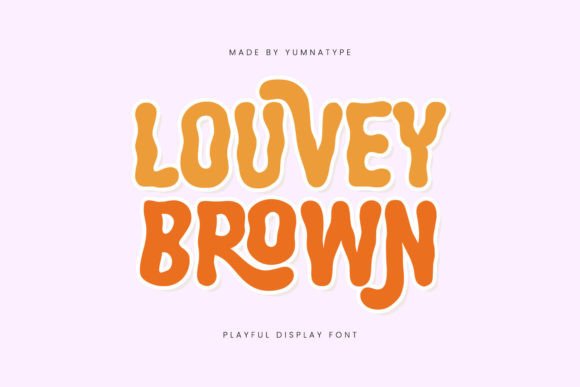
Louvey Brown: A Bold Display Font with Whimsy and Character
In the crowded landscape of digital typography, where sleek sans-serifs and rigid geometric forms often dominate screen real estate, there is a distinct need for typefaces that breathe personality into a design. Louvey Brown emerges as a captivating display font that commands attention not through aggression, but through a unique aesthetic that balances bold presence with an inviting softness. For designers, marketers, and creators looking to break the monotony of standard web fonts, understanding the nuances of this typeface offers a pathway to more engaging visual communication.
The essence of Louvey Brown lies in its ability to stop the scroll. It is not merely a vessel for text; it is a graphic element in its own right. The uppercases of Louvey Brown demand attention, creating a strong visual impact that can anchor a header or a logo instantly. Yet, despite this commanding stature, the font avoids feeling harsh or industrial. Instead, the fairly thick weight adds to its boldness while maintaining a sense of warmth, making it a versatile tool for various creative workflows.
The Anatomy of a Unique Typeface
To truly appreciate the utility of Louvey Brown, one must look closely at its structural components. Typography is often described as architecture, and here, the architecture is built on a foundation of rounded shapes and irregular outlines. Unlike the precise, mathematical curves found in many modern geometric fonts, the letters in this family possess a hand-crafted quality that feels organic and human.
The rounded shapes of the letters give the font a soft and friendly appearance, inviting viewers to engage with your text. This characteristic is particularly valuable in industries where approachability is key, such as education, children's products, or lifestyle branding. When a viewer encounters a headline set in Louvey Brown, the lack of sharp corners subconsciously signals safety and friendliness, lowering the barrier to entry for reading the content.
However, the defining feature that sets this typeface apart from other rounded display fonts is the inclusion of uneven outlines. Adding to its distinctive style, Louvey Brown shows uneven outlines that add a touch of whimsy and character. This irregularity adds visual interest and creates a dynamic texture that sets it apart from other display fonts. In a world of perfect vector lines generated by algorithms, these imperfections act as a signature, suggesting that a human hand was involved in the creation process. This "wobbly" edge prevents the text from feeling sterile, adding a layer of depth that flat colors cannot achieve.
Visual Weight and Legibility Considerations
When implementing a bold display font like Louvey Brown, the interplay between weight and legibility becomes a critical consideration. The fairly thick weight ensures that the text remains visible even at smaller sizes or against complex backgrounds, which is a common challenge in modern web design. However, because the font is designed primarily for display purposes, it shines brightest when used in larger point sizes.
Designers should note that the uneven outlines can sometimes create challenges when scaling down too far. At very small sizes, the texture created by the irregular edges may blur, reducing readability. Therefore, the strategic application of this font is essential. It is best utilized for headlines, pull quotes, logos, and short phrases where the visual impact is the primary goal, rather than for body copy requiring sustained reading.
Strategic Applications in Modern Design
The versatility of Louvey Brown extends across multiple sectors, offering solutions for professionals ranging from freelance graphic designers to corporate marketing teams. Its unique blend of boldness and playfulness makes it suitable for contexts that require a departure from the traditional corporate aesthetic without sacrificing professionalism.
- Brand Identity and Logos: For startups and small businesses aiming to establish a memorable identity, Louvey Brown serves as an excellent choice for logo design. The uneven outlines provide a custom feel that distinguishes the brand from competitors using standard stock fonts. The bold uppercase letters ensure the brand name is instantly recognizable, even on social media profile pictures or business cards.
- Packaging Design: In the retail sector, packaging is the silent salesman. Products targeting families, artisans, or the eco-conscious market benefit greatly from the friendly yet robust nature of this typeface. Imagine a label for a craft coffee roaster or an organic snack line; the rounded shapes suggest natural ingredients, while the bold weight conveys quality and substance.
- Digital Marketing Assets: Social media graphics and banner ads compete for attention in milliseconds. The strong visual impact of Louvey Brown makes it ideal for call-to-action buttons, promotional headers, and event posters. The whimsical character helps the content stand out in a feed dominated by clean, minimalist designs.
- Educational Materials: Educators and content creators producing materials for younger audiences will find the soft, rounded appearance highly effective. It reduces the intimidation factor of text-heavy pages, making learning materials feel more like a storybook and less like a textbook.
Navigating the Balance of Whimsy and Professionalism
While the character of Louvey Brown is undeniable, successful implementation requires a nuanced understanding of context. The uneven outlines and thick weight are powerful tools, but they must be wielded with care to avoid overwhelming the viewer. The key lies in pairing this display font with a neutral, highly readable secondary typeface.
A common workflow involves using Louvey Brown exclusively for H1 and H2 headings, allowing the text to command the hierarchy immediately. For the body paragraphs, a simple sans-serif or a classic serif font provides the necessary contrast. This combination allows the personality of the display font to shine without compromising the readability of the informational content. The juxtaposition of the whimsical, textured headlines against clean, structured body text creates a rhythm that guides the reader's eye naturally through the layout.
Furthermore, color plays a significant role in how the font is perceived. Because the font already possesses a heavy visual weight due to its thickness, pairing it with high-contrast colors can enhance its impact. Deep browns, vibrant oranges, or rich purples complement the earthy, grounded feel of the name itself. Conversely, using it in white against a dark background can highlight the uneven outlines, making the texture pop and adding a three-dimensional quality to the design.
Trends in Textural Typography
The rise of Louvey Brown aligns with a broader trend in the design community toward "imperfect" perfection. As users become fatigued by the hyper-clean, algorithmic aesthetics of the early 2010s, there is a growing appreciation for textures that evoke nostalgia and humanity. Fonts that mimic hand-lettering, brush strokes, or uneven printing are becoming increasingly popular in both print and digital media.
This shift reflects a desire for authenticity. Consumers today are savvy; they can detect when a brand is trying too hard to appear polished. The irregularity found in Louvey Brown signals honesty and creativity. It suggests that the brand behind the design is willing to take risks and embrace individuality. For researchers and analysts tracking design trends, the adoption of such fonts indicates a move away from strict minimalism toward maximalist expression and emotional connection.
Technical Implementation and Accessibility
From a technical standpoint, integrating a display font like Louvey Brown into a project requires attention to file formats and loading times. Web designers should ensure that the font files are optimized for web use, utilizing formats like WOFF2 to minimize bandwidth usage. Since display fonts are often loaded only once per page visit, caching strategies can help maintain fast load speeds, ensuring that the visual impact does not come at the cost of user experience.
Accessibility is another crucial factor. While the font is visually striking, the uneven outlines and thick weight must be evaluated for readability by users with visual impairments. High contrast ratios are essential. Additionally, because the font is best suited for headlines, it should not be relied upon for conveying critical information in long-form text where cognitive load is a concern. By adhering to these guidelines, creators can ensure that their designs are inclusive while still leveraging the unique aesthetic of the typeface.
Cultivating a Distinctive Visual Voice
Ultimately, the decision to use Louvey Brown is a decision to prioritize character over conformity. In a digital ecosystem where thousands of websites share similar layouts and standard typefaces, choosing a font with such a distinct personality is a strategic move. It communicates confidence and a willingness to engage with the audience on an emotional level.
Whether you are a hobbyist designing a personal blog, a business owner launching a new product line, or a professional designer crafting a campaign, the characteristics of this font offer a wealth of possibilities. The rounded shapes invite engagement, the bold weight demands respect, and the uneven outlines tell a story of human craftsmanship. By understanding how to harness these elements, creators can transform simple text into a compelling visual narrative that resonates deeply with their intended audience.
As the design landscape continues to evolve, typefaces that offer a balance of strength and softness will remain invaluable. Louvey Brown stands as a testament to the power of thoughtful typography, proving that even the smallest details, like an irregular outline, can make a monumental difference in how a message is received and remembered.